Villoc is a heap visualisation tool, it's a python script that renders a static html file. An example can be seen here: http://wapiflapi.github.io/villoc/, this is villoc running on an exploit of PlaidCTF 2015's challenge PlaidDB.
The easiest way to use villoc against a binary that uses "malloc" functions is probably to run the following command and open out.html in a browser.
ltrace ./target |& villoc.py - out.html;It is probably a good idea to disable ASLR for repeatable results and to use a file to pass the ltrace to villoc because otherwise the target's error output will be interleaved and might confuse villoc sometimes.
setarch x86_64 -R ltrace -o trace ./target; villoc.py trace out.html;Use with caution, not very stable yet
LD_PRELOAD="./ldpreload/libvilloc.so" ./target |& villoc.py - out.htmlLD_PRELOAD="/path/to/frida-gadget.so" FRIDA_GADGET_SCRIPT="./frida/malloc_hook.js" ./target |& villoc.py - out.html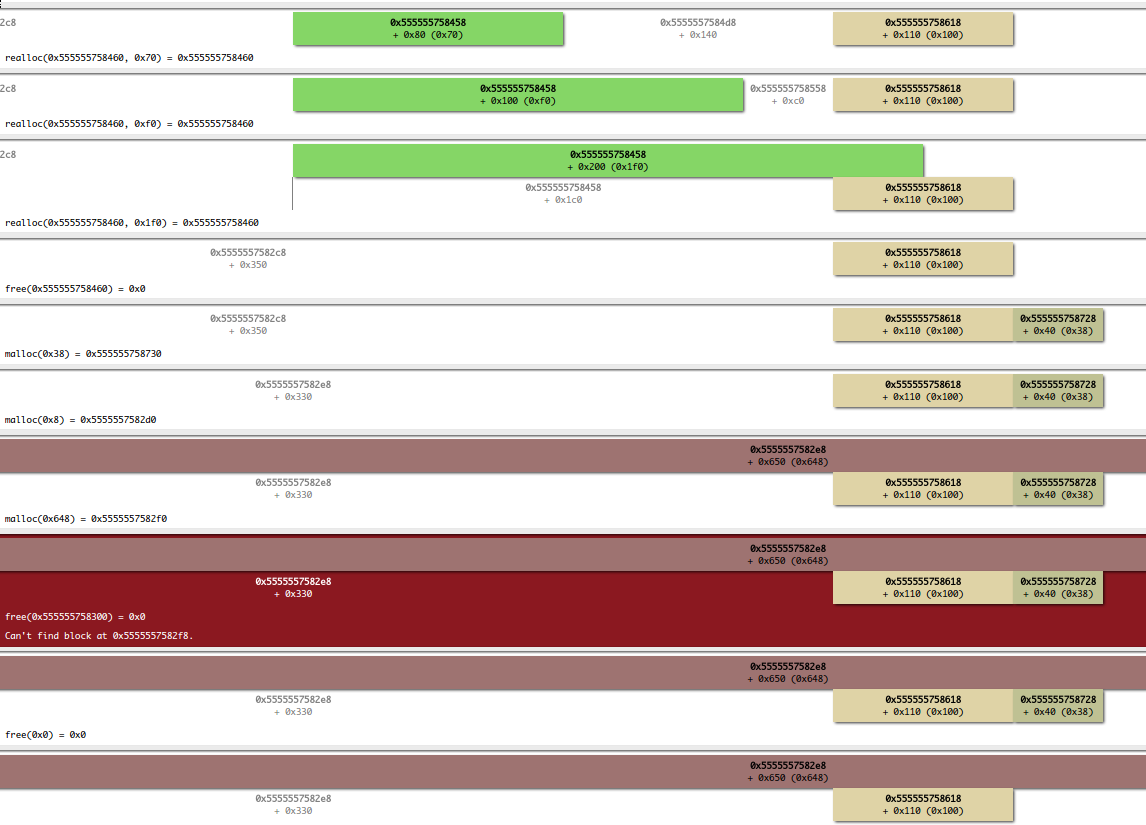
This has been made with glibc's dl_malloc (and its derivates like ptmalloc2) in mind. But it should work for other
implementations, especially if you play with the --header and --footer
options to indicate how much overhead the targeted malloc adds to the user data.