


Each engineering habit gets an installed skill. In Claude Code, type the slash command. In Codex, invoke the installed skill by name and follow the same playbook.
| Skill | When | What it does |
|---|---|---|
/think |
Before building anything new | Challenges the problem, pressure-tests the design, and produces a decision-complete plan another agent can implement. |
/ui |
Building frontend interfaces | Produces distinctive UI, including screenshot-driven aesthetic iteration, with a committed direction rather than generic defaults. |
/check |
After a task, before merging or release | Reviews the diff, extracts project-specific constraints, handles approved release/publish/push/reaction follow-through, and verifies with evidence. |
/hunt |
Any bug, regression, or unexpected behavior | Systematic debugging. Root cause confirmed before any fix is applied, especially when something used to work. |
/write |
Writing or editing prose | Rewrites prose to sound natural in Chinese and English. Cuts stiff, formulaic phrasing. |
/learn |
Diving into an unfamiliar domain | Six-phase research workflow: collect, digest, outline, fill in, refine, then self-review and publish. |
/read |
Any URL or PDF | Reads URLs and PDFs with platform-specific routing. Plain reads return a concise summary; Markdown output is used when asked to convert, quote, cite, save, or feed downstream work. |
/health |
Auditing Agent Health | Checks Codex, Claude Code, project instructions, verifier output, and AI maintainability with a budget-aware summary pass before deep inspection. |
Each skill is a folder with reference docs, helper scripts, and gotchas from real failures.
One command installs all eight skills, with no prompts and no errors. Copy and run:
npx skills add tw93/Waza -a claude-code codex cursor -g -yThis installs to Claude Code, Codex, and Cursor, plus any other agent that reads the shared ~/.agents/skills directory. Update later with npx skills update -g -y, or pass one agent (e.g. -a claude-code) to scope it.
Native plugin (for host-native update commands)
# Claude Code: install, then `claude plugin update waza`
/plugin marketplace add tw93/Waza
/plugin install waza@waza

# Codex: install, then `codex plugin marketplace upgrade waza`
codex plugin marketplace add tw93/Waza
codex plugin add waza@waza
Claude Desktop: download waza.zip, then Customize > Skills > "+" > Create skill, and upload the ZIP. Re-upload the latest ZIP to update.
Pi: pi install npm:@tw93/waza (update with pi update npm:@tw93/waza). /health audits Pi settings alongside Claude Code and Codex.
Skills chain together, but every transition is a manual step you trigger. Each skill finishes its task and stops, waiting for you to decide what comes next.
Common workflows:
- Plan a feature:
/think→ approve → say "implement X" →/check→ merge - Ship a fix:
/hunt→ fix →/check→ release/publish/push/issue follow-through - Research and write:
/read(fetch sources) →/learn(synthesize) →/write(polish) - Debug and verify:
/hunt(find root cause) → fix →/check(review changes)
Waza ships only generic engineering habits. /check becomes project-aware at runtime by reading the target repository's public context (READMEs, package manifests, Makefiles, CI workflows) and your task constraints, never private paths, credentials, or tokens. See skills/check/references/project-context.md for the review context template.
A minimal statusline for Claude Code: context window, 5-hour quota, and 7-day quota. Color-coded by usage, no progress bars, no noise.
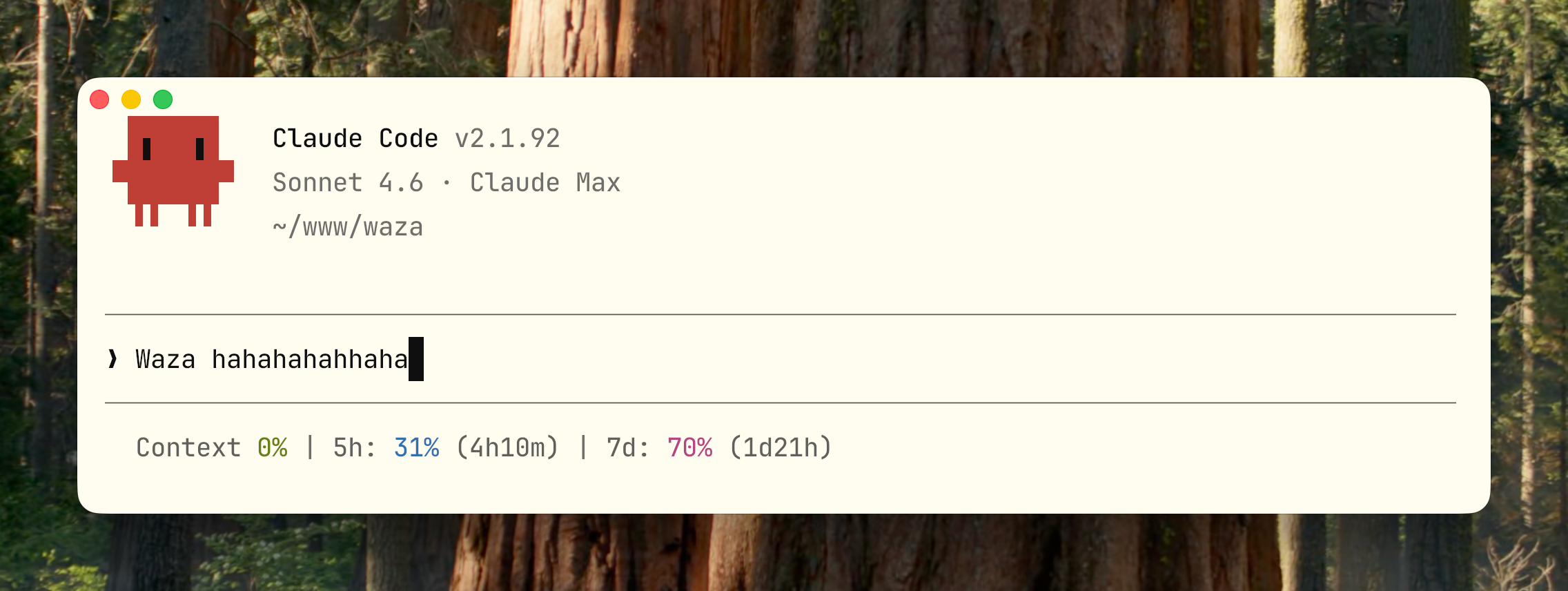
curl -sL https://github.com/tw93/Waza/releases/latest/download/setup-statusline.sh | bashCodex has native statusline items. Add to ~/.codex/config.toml:
[tui]
status_line = ["model-with-reasoning", "current-dir", "context-used", "five-hour-limit", "weekly-limit"]
status_line_use_colors = true
Codex shows remaining quota; the Claude Code statusline above shows used percentage (upstream does not yet expose five-hour-used / weekly-used).
Three independent toggles. Copy the ones you want (swap claude-code for codex on Codex):
# English coaching: appends a short 😇 correction when your prompt has an English mistake
curl -sL https://github.com/tw93/Waza/releases/latest/download/setup-rule.sh | bash -s -- english claude-code

# Anti-patterns: always-on cross-skill guardrails (read before acting, no scope creep, no unsolicited summaries)
curl -sL https://github.com/tw93/Waza/releases/latest/download/setup-rule.sh | bash -s -- anti-patterns claude-code

# Routing hint: tells non-Claude hosts to prefer Waza skills when a request matches their triggers
curl -sL https://github.com/tw93/Waza/releases/latest/download/setup-rule.sh | bash -s -- waza-routing claude-code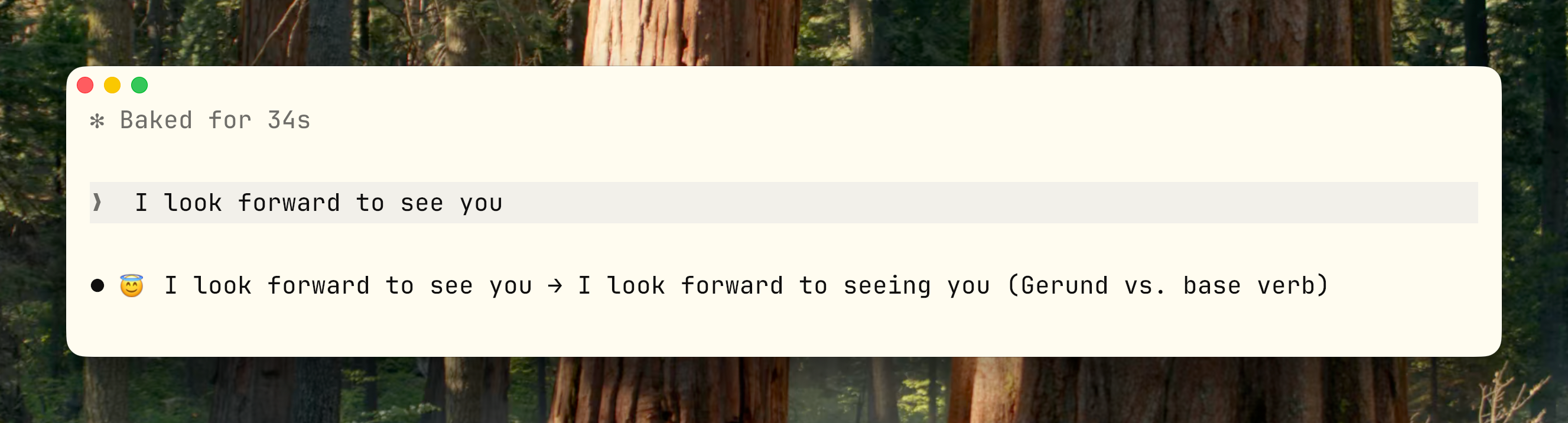
Curl URLs use the latest GitHub release asset. Set WAZA_REF=main before the command if you want bleeding-edge scripts.
Waza (技, わざ) is a Japanese martial arts term for technique: a move practiced until it becomes instinct.
A good engineer does more than write code. They pressure-test requirements, debug to root cause, review their own diffs, and read primary sources. AI has the raw output for all of it, but without structure that output drifts into generic, imprecise work. Each Waza skill sets a clear goal and the constraints that matter, then steps back and lets the model work. As models improve, that restraint pays compound interest.
Tools like Superpowers and gstack are powerful but heavy: too many skills, too much configuration. Waza stays small, eight skills for the habits that actually matter, each with one job and a clear trigger. Built from real projects and refined through 300+ sessions across 7 projects, every gotcha traces to a real failure. The /health skill grew from the six-layer Claude Code framework in this post.
Part of a trilogy: Kaku (書く) writes code, Waza (技) drills habits, Kami (紙) ships documents. Think of them as a family: Kaku is the dad, Waza the big sister, Kami the little sister.
npx skills remove tw93/Waza -g
rm -f ~/.claude/statusline.sh
rm -f ~/.claude/rules/english.md
rm -f ~/.claude/rules/anti-patterns.md
rm -f ~/.claude/rules/waza-routing.md
For Claude Desktop, delete Waza from Customize > Skills. For Codex rule installs, remove the marked Waza blocks from ~/.codex/AGENTS.md.
- The most direct way to support me is getting Mole for Mac, my paid Mac cleanup app.
- If Waza helped you, give it a star, share it, or open an issue or PR.
- I have two cats, TangYuan and Coke. If you think Waza delights your life, you can feed them canned food 🥩.
These lovely people already did 🐱

MIT License. Feel free to use Waza and contribute.